Getting your car ready for winter: tires, chains and the rules in the US and Europe
Contents
Winter driving season is here, and the rules depend on where you are. In the U.S., each state sets its own requirements: Colorado can require traction tires or chains on I-70, and California posts chain controls in the mountains. In Europe, France has required winter equipment in designated mountain towns since November 1, 2026, and Spain restricts snowy roads by color-coded level. Here is what to check before you go.
What are the rules in the U.S.?
There is no single nationwide rule; check the state you will drive in. Two widely followed examples:
Colorado: traction and chain laws
- On I-70 between Morrison and Dotsero, from September 1 to May 31, or whenever conditions require, the traction law can be enforced with fines.
- Under the traction law, passenger vehicles need tires with at least 3/16-inch tread, rated all-weather or winter (mountain-snowflake icon, M+S or M/S), or must carry chains or an approved alternative traction device.
- Under the chain law, the last step before a closure, every vehicle must have chains or an approved alternative device.
- Fines: $100 plus a $33 surcharge; if non-compliance leads to a lane closure, up to $500 plus a $157 surcharge.
California: chain controls
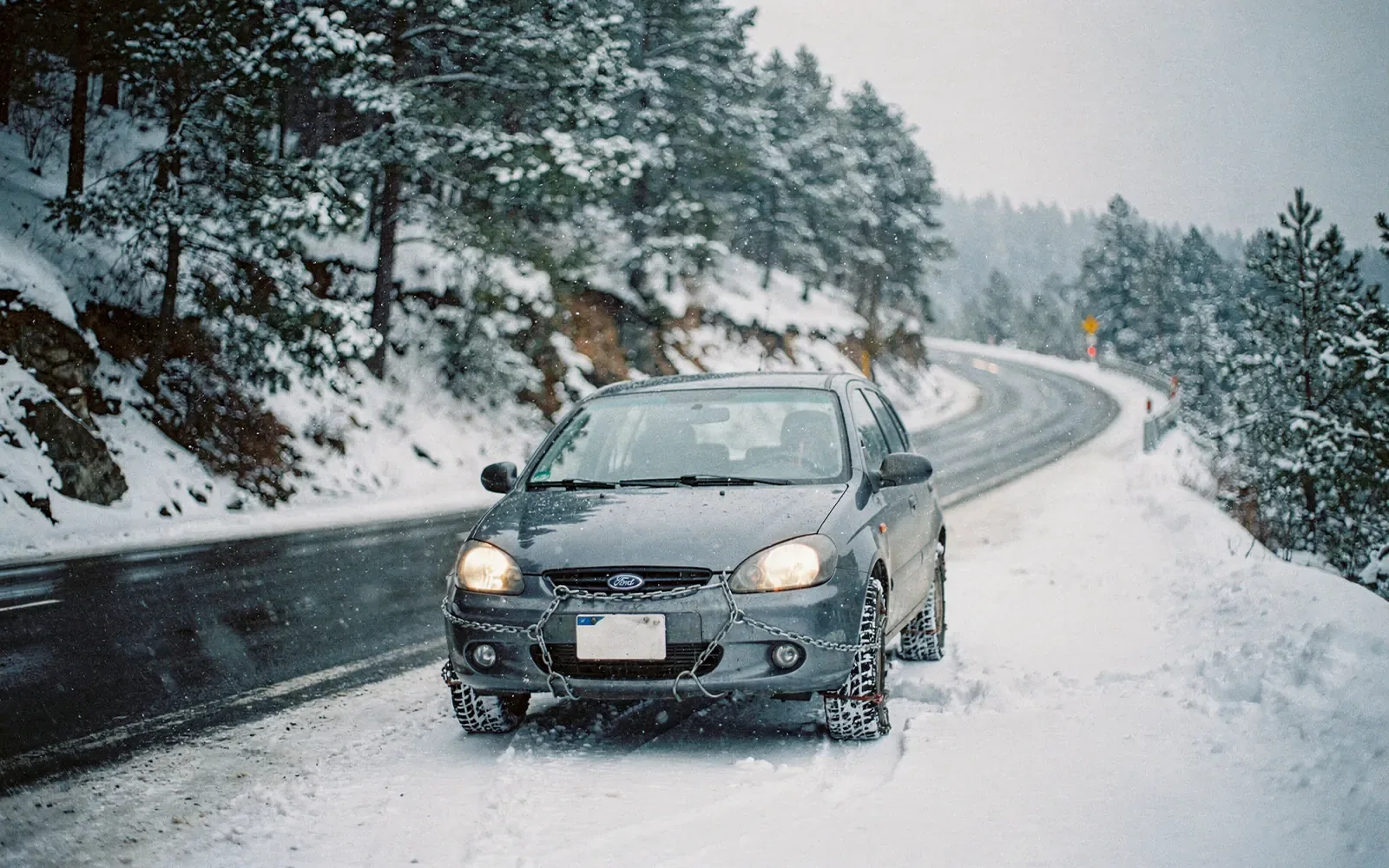
When chain controls are in place, signs show the requirement. Caltrans says you must stop and put on chains when signs say they are required, or risk a citation from the California Highway Patrol. You usually have about a mile between the "Chains Required" sign and the checkpoint, and the speed limit with chains is 25 or 30 mph. Chains go on the drive wheels, so know whether your car is front- or rear-wheel drive.
What does France require?
Under France's mountain law, from November 1 to March 31, cars, light vans and motorhomes in signposted areas must either have four winter tires or carry chains (metal or textile "socks") for at least two drive wheels, according to the French Road Safety Delegation. Studded tires are exempt. Designated towns are set by local prefects across six ranges: the Alps, Pyrenees, Jura, Vosges, Massif Central and Corsica.
Since November 1, 2024, tires marked only M+S no longer count on their own: you need the three-peak mountain snowflake symbol (3PMSF), or chains on board as well. A €135 fine exists on paper, but Neozone, citing the specialist outlet Roole, reports that it still cannot be enforced because the implementing decree is missing.
And in Spain?
Spain has no fixed calendar. The traffic authority, the DGT, uses color levels shown on its Infocar map and on the 011 hotline.
| Level | Road condition | What applies |
|---|---|---|
| Green | Little affected | Max 100 km/h (62 mph) on motorways, 80 km/h (50 mph) elsewhere; trucks stay right, no passing |
| Yellow | Snow starting to cover the road | Trucks and articulated vehicles banned; cars and buses max 60 km/h (37 mph) |
| Red | Road fully covered | Chains or special tires only, max 30 km/h (19 mph); trucks, articulated vehicles and buses banned |
| Black | Road closed | No traffic at all |
The DGT's magazine says metal chains should not exceed 30 km/h and textile ones 50 km/h, and that only tires with the three-peak symbol let you drive without chains where they are mandatory. During snow episodes, as in February 2026, the DGT says it may restrict vehicles without winter tires, all-season tires or chains, and asks drivers to keep the left lane free for snowplows.
Your pre-trip checklist
Caltrans recommends checking brakes, wipers, defroster, heater, exhaust, antifreeze and tire pressure and tread, and carrying:
- chains in the right size for your tires, a flashlight and chain repair links;
- an ice scraper or de-icer, a broom and a shovel;
- sand or burlap for traction;
- water, food, warm blankets and extra clothing;
- a full tank and a spare key in your pocket.
Heading to Europe's Christmas markets by car? Check the rules in every country you cross. And at home, see our tips to cut your heating bill.
Frequently asked questions
Do all-season tires count in Colorado?
Under the traction law, tires rated all-weather or winter (mountain-snowflake, M+S or M/S) with at least 3/16-inch tread are accepted. Under the chain law, you need chains or an approved device.
Can I use textile snow socks?
Colorado publishes its list of approved alternative traction devices online, so check it before you buy. France accepts textile chains. In California, follow the posted chain-control signs.
Where do I check road conditions?
Caltrans QuickMap in California, COtrip.org in Colorado, the DGT's Infocar map or 011 in Spain.
Are M+S tires enough in France's mountains?
Not on their own since November 1, 2024. You need the three-peak snowflake symbol, or chains on board.
Sources
- French Road Safety Delegation, winter equipment leaflet (in French) (October 2021)
- Neozone, France's 2026–2027 winter equipment rules (in French) (November 1, 2026)
- DGT (Spain's traffic authority), trip planning and snow levels (in Spanish) (December 1, 2021)
- DGT magazine, driving on snow and ice (in Spanish) (December 18, 2023)
- DGT magazine, winter tyres explained (in Spanish) (December 30, 2024)
- DGT press release on snow measures (in Spanish) (February 3, 2026)
- Colorado DOT, Passenger Vehicle Traction and Chain Laws (accessed November 17, 2026)
- Caltrans, Winter Driving Tips (accessed November 17, 2026)