Heating bills: 9 ways to cut the cost this winter
Contents
- How much does one degree really save?
- The nine moves, one by one
- 1. Pick a moderate daytime setting
- 2. Set back at night and when you're out
- 3. Let a thermostat do the work
- 4. Control each radiator
- 5. Use your curtains
- 6. Keep vents and radiators clear
- 7. Seal air leaks
- 8. Air out briefly, heat off
- 9. Maintain the system
- Are there rules on maintenance?
- Frequently asked questions
- Sources
Heating is one of the biggest bills of the winter, and part of it is set at the thermostat. The U.S. Department of Energy (DOE) says you can save as much as 10% a year on heating and cooling by turning your thermostat down 7–10°F for 8 hours a day in fall and winter. France's ADEME and Spain's IDAE agree on a simple rule of thumb: roughly 7% less heating energy for each degree Celsius. Here are nine moves that matter, with their sources.
How much does one degree really save?
DOE's figure is a ceiling, not a promise: "as much as" 10% a year for a daily 8-hour setback of 7–10°F. In Europe, ADEME's electricity guide states "1 °C less = 7% savings", and IDAE writes that each extra degree raises energy use "by approximately 7%". One degree Celsius equals 1.8°F.
Real savings depend on your insulation, climate and fuel. To see how energy costs fit into the wider picture, read our explainer on inflation and interest rates.
| Room or time | ADEME (France) | IDAE (Spain) |
|---|---|---|
| Living areas in use | 19°C (66°F) | 19–21°C (66–70°F) |
| Living areas empty | 16–17°C (61–63°F) | 15°C (59°F) when out for a few hours |
| Bedroom at night | 17°C (63°F) | 15–17°C (59–63°F) |
| Bathroom | 22°C (72°F) while in use, 16–17°C otherwise | Not specified |
| Long absence | Frost-protection mode | Lower by 4–5°C (7–9°F) |
The nine moves, one by one
1. Pick a moderate daytime setting
ADEME's benchmark is 19°C (about 66°F) in occupied living areas; IDAE says 19–21°C is enough for most people. A warm sweater beats turning up the heat, ADEME adds.
2. Set back at night and when you're out
This is the DOE's headline tip: a 7–10°F setback for 8 hours a day. ADEME suggests 17°C (63°F) in bedrooms at night and a frost-protection mode for long trips.
3. Let a thermostat do the work
A programmable or smart thermostat runs the schedule for you. ADEME says a programmable thermostat saves 15% of heating energy on average; IDAE puts savings from thermostatic valves and programmable thermostats at 8–13%.
4. Control each radiator
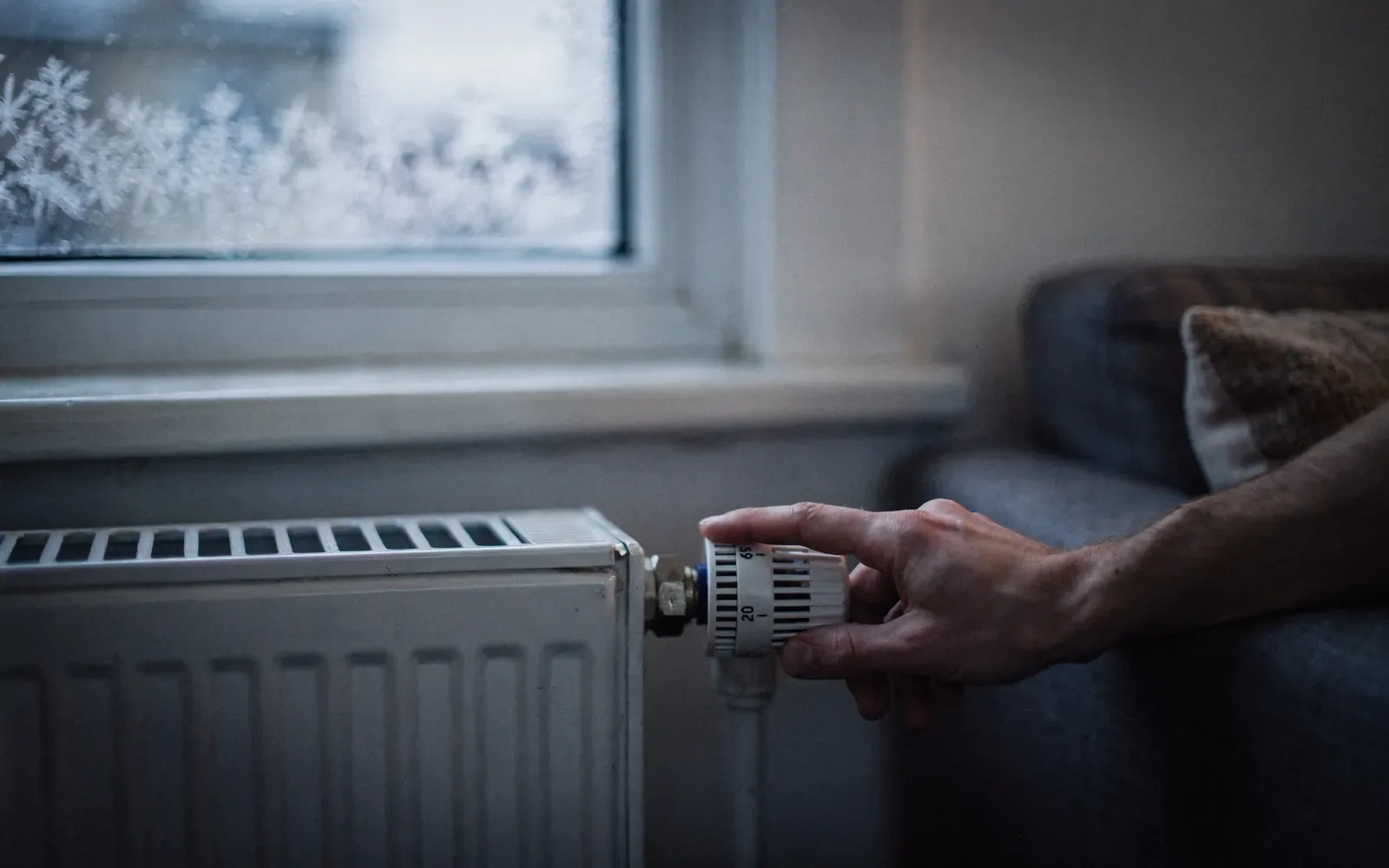
On hot-water radiators, thermostatic valves set the temperature room by room. IDAE notes they also make use of free heat from cooking or sunshine.
5. Use your curtains
DOE advises opening drapes and shades on south-facing windows during the day to let the sun in, and closing them at night to reduce the chill from cold windows. ADEME gives the same advice, and IDAE recommends closing them at night.
6. Keep vents and radiators clear
DOE recommends cleaning warm-air registers, baseboard heaters and radiators and making sure furniture, carpets or drapes do not block them. ADEME adds: do not dry laundry on radiators.
7. Seal air leaks
Caulk, seal and weatherstrip seams, cracks and openings to the outside. By sealing uncontrolled air leaks, DOE says, you can save 10–20% on heating and cooling bills. Door draft stoppers and closing the fireplace damper when not in use help too, according to ADEME.
8. Air out briefly, heat off
Fresh air still matters in winter. ADEME recommends about 10 minutes a day with radiators turned off; IDAE also says around 10 minutes is enough to renew the air in a room.
9. Maintain the system
DOE suggests cleaning or replacing furnace filters once a month or as recommended, and bleeding trapped air from hot-water radiators once or twice a season. IDAE estimates that proper boiler maintenance can save up to 15% of energy.
Are there rules on maintenance?
Follow your manufacturer's service schedule and any local requirements. In France, for comparison, ADEME notes that the law requires an annual service for oil, gas and wood boilers, a check every two years for heat pumps, and chimney sweeping at least once a year. ADEME also discourages plug-in space heaters as inefficient add-ons.
Trimming other winter costs? Try our budget-friendly winter soups and our guide to getting your car ready for winter.
Frequently asked questions
Is it cheaper to turn the heat off or down when I leave?
Turning it down is the usual advice. DOE's estimate is based on an 8-hour setback of 7–10°F, and ADEME recommends a frost-protection mode for long absences rather than switching off entirely.
Is the 10% saving guaranteed?
No. DOE says "as much as" 10% a year. Results depend on your home, climate and equipment.
What is the most effective quick fix?
Sealing air leaks is among the quickest money-saving tasks, DOE says, with possible savings of 10–20% on heating and cooling bills.
Where can I get personalized help?
DOE's Energy Saver guide describes professional home energy audits, which test for air leaks and missing insulation..
Sources
- ADEME (French ecological transition agency), winter heating guide (in French) (September 2026)
- ADEME, guide to cutting your electricity bill (in French) (December 2024)
- IDAE (Spain's energy agency), Practical Energy Guide (in Spanish) (2007 edition)
- U.S. Department of Energy, Energy Saver guide (August 2022)